Automation,Email Marketing

Building an Ecommerce Email Flow That Actually Recovers Abandoned Carts
Every ecommerce store loses carts.
Someone adds a product, gets distracted, gets a phone call, sees the shipping cost and hesitates.
It happens dozens of times a day, even on a healthy store. The difference between a brand that recovers a meaningful share of that revenue and one that does not usually comes down to three emails and the order they arrive in. This guide covers the full setup, from strategy to timing to what to test next.
Key takeaways
- A single reminder email leaves most of the recoverable revenue on the table.
- Three emails, each answering a different objection, consistently outperform one generic nudge.
- Leading with a discount trains customers to wait for one on every future order.
- High value carts often convert better with a human reply than another automated email.
- Segmenting by order value and customer history makes the whole flow work harder.
Why abandoned carts happen in the first place
Not every abandoned cart is a lost sale. Some are.
People get interrupted mid checkout. They open a new tab to compare a competitor. They realize shipping costs more than expected. They were never fully committed to buying in the first place.
A good recovery flow does not try to save every single cart. It tries to answer the specific reason each type of visitor did not finish, which is why one generic email undersells what is possible.
Why most abandoned cart flows underperform
The common setup is one email, sent an hour or a day later, reminding the customer what they left behind.
It works, a little. Most stores see a small bump from that single reminder and stop there, treating the job as done.
The problem is that a single email treats every abandoned cart the same way, whether someone was seconds from paying or never really planning to buy at all. One email cannot do three jobs at once, so it ends up doing the easiest one, the simple reminder, and leaving the harder objections unanswered.
A structure that actually works
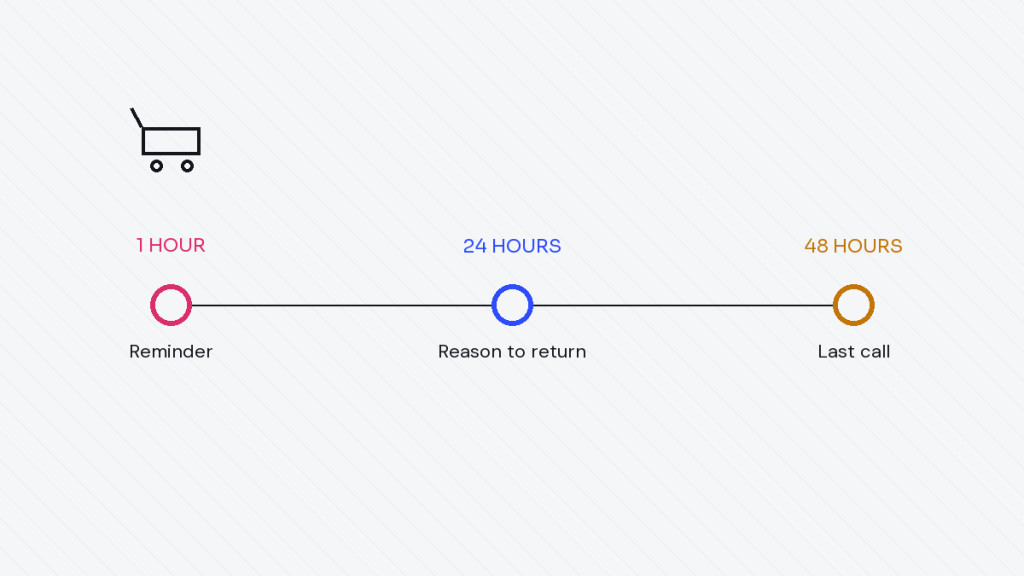
Three emails, spaced with intent, each doing a different job.
This is not about sending more email. It is about splitting one vague message into three specific ones, each aimed at a different reason someone did not finish checking out.
1 hour
The reminder
A simple nudge with the product, the price, and a direct link back to checkout. No discount yet. This email is for the person who was genuinely about to buy and just got interrupted. Most recovered carts come from this email alone, which is exactly why it should stay simple and not lead with an offer that trains people to wait for one.
24 hours
The reason to come back
Answer the objection that is actually stopping them: shipping cost, sizing, reviews, or a return policy. This is where trust closes the gap, not price. If the store sells apparel, a sizing guide or fit note earns its place here.
48 hours
The last call
A small, time limited incentive for the customers who needed one. Keep it modest. A flow that leads with a discount trains customers to wait for one every time, which quietly erodes margin on every single order, not just the recovered ones.
A cart recovery flow is not a discount machine. It is three chances to answer a different doubt.
Getting the segmentation right
Not every abandoned cart deserves the same three emails.
A cart worth twelve dollars and a cart worth four hundred dollars are different conversations. For higher value carts, it is worth holding back the discount entirely and instead offering a direct line to a real person, a chat message or a reply to email that goes to someone who can actually answer a question.
Repeat customers are another case worth separating out. Someone who has already bought twice does not need convincing that the brand is trustworthy. For them, the first email can often be the only one that matters.
New visitors who abandon on their very first session are a third group worth treating differently again. The second email carries more weight for them, since this is often the first real chance to build trust through reviews, guarantees, or a clear return policy.
Building the segments without extra manual work
None of this needs to be built by hand.
A workflow tool like Zapier or Make can read the order value and customer history from the store and route each abandoned cart into the right version of the flow automatically. Once that routing is set up once, it keeps working on every cart that comes through.
Quick setup checklist
- Confirm the store platform can trigger on cart abandonment, not just on session end.
- Write three distinct emails before building anything, each answering one objection.
- Hold the discount for the third email only, and keep it modest.
- Segment high value carts for a human follow up instead of an automated discount.
- Track recovered revenue per email, not just overall flow performance.
What to test next
Once the structure is live, the highest leverage tests are usually the subject line on the first email and the incentive size on the third.
Resist the urge to add a fourth email before those two are settled. A fourth email rarely adds meaningful recovery and usually just adds an unsubscribe.
Timing itself is worth testing too, but only after the content of each email is doing its job. The content of each message, and whether it is actually solving a real objection, moves the number a lot more than shifting it by a few hours.
Where to track the results
Keep a simple record of recovered revenue per email in whatever dashboard the rest of the store’s numbers already live in.
A cart flow that nobody is tracking tends to quietly decay as products change and the offers stop matching what is actually in the store.
Frequently asked questions
How many emails should an abandoned cart flow have
Three is usually the sweet spot for most ecommerce stores. Each one should answer a different reason someone did not finish checking out, rather than repeating the same message.
Should the first email include a discount
No. The first email should stay a simple, honest reminder. Leading with a discount trains shoppers to wait for one on every order, which slowly erodes margin.
What if a customer has abandoned carts multiple times
Consider capping how often they enter the automated flow, and route frequent abandoners toward a real conversation instead of another automated discount.
Does this work for low priced products too
Yes. The structure works at any price point. The main difference is how aggressive the final incentive should be, since margins are tighter on lower priced items.
The short version
Get this right and the flow keeps recovering revenue quietly in the background, which is the entire point of building marketing systems instead of running one off campaigns.
Nobody has to remember to send it, nobody has to write new copy every week, and it keeps paying back the few hours it took to set up for as long as the store is running.
Dhanik
I build the automation and marketing systems that let ecommerce brands grow without adding more manual work: email and SMS flows, workflow automation, reporting, and the content and SEO that feeds all of it. Currently building these systems at TechDeliveryPartners, after four years running SEO and content at KonixWeb, and seven years total in search and digital marketing.
View full profile