SEO,Ecommerce

How to Optimize Your Ecommerce Website for AI Agents
More shoppers are letting AI agents do the searching for them.
They type one sentence into a chat tool. The tool goes and compares products across the web. Then it gives a short answer, sometimes with a direct link to buy.
Your store needs to be readable by that agent, not just by a person scrolling on their phone. Here is a full breakdown of what that actually means and how to get there.
Key takeaways
- AI agents read your site differently than a normal shopper does.
- Clear structure and clean data matter more than clever design.
- Product facts need to be easy to find, not buried in images or scripts.
- Most of this work overlaps with good, ordinary SEO. It is not a separate skill.
What is an AI agent, in plain terms
An AI agent is a tool that can browse, compare, and sometimes act on your behalf.
Examples include AI chat tools that answer shopping questions, AI powered search modes built into search engines, and shopping assistants built into some platforms.
The common thread is this: instead of a person clicking through five tabs, the agent does the comparing and reading, then presents a short summary or a direct recommendation.
How an agent actually reads your site
It does not scroll like a person.
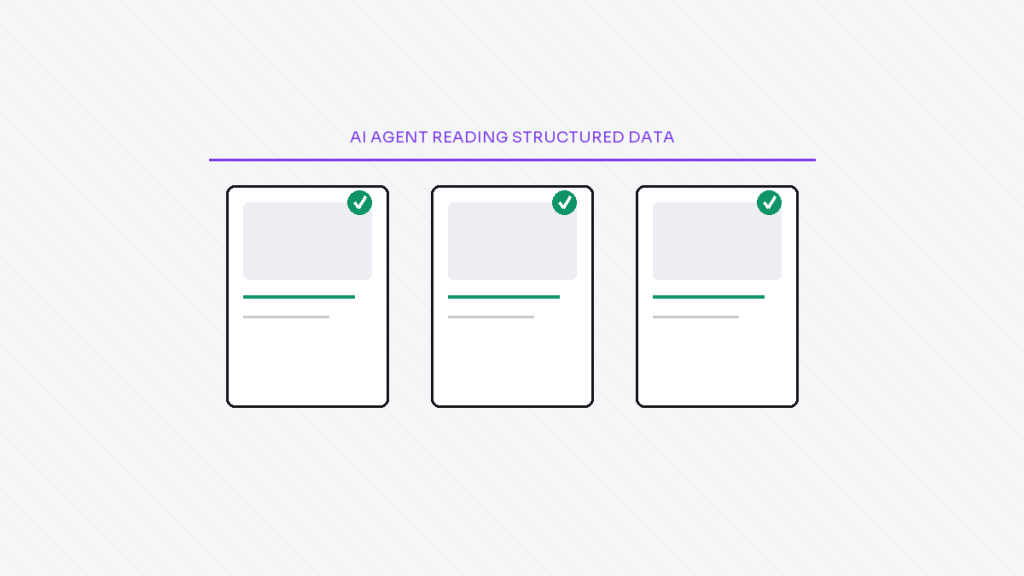
It reads the page structure, the visible text, and the structured data behind the page.
If your price, stock status, and product details are easy to find in clean text, the agent can use them.
If they are locked inside an image, a slider, or a script that only runs after a click, the agent may miss them completely.
Start with clean product data
This is the biggest lever most stores are missing, and it is also one of the most fixable.
Product schema markup
Schema is a standard way of labeling data so machines understand it instantly: the name, the price, the currency, the availability, the reviews.
Without schema, an agent has to guess at your price by reading page text, which is slower and more error prone.
With schema, the price, stock status, and rating are labeled clearly, and mistakes drop sharply.
Getting schema set up correctly
RankMath can handle most of this automatically once it is set up properly on your product pages.
Check that price, currency, availability, SKU, and brand are all filled in, not just the product name and description.
Test your pages with a structured data testing tool after setup, to confirm nothing is missing or broken.
Write pages that answer the real question
AI agents favor pages that clearly answer a specific question.
A product page that says what the item does, who it is for, and what makes it different will get picked up more often than a page full of vague marketing language.
This is the same advice that works for normal search rankings covered in what still works in search. It is not a separate skill, just applied with cleaner data behind it.
Comparison content helps agents more than you might think
Agents are often asked to compare products, not just describe one.
A simple, honest comparison table or paragraph, covering size, material, price range, and who each option suits best, gives the agent something concrete to work with.
Optimizing for AI agents is mostly just doing good SEO properly, with cleaner data behind it.
Keep your site fast and simple
A slow, heavy page is hard for an agent to process quickly, the same way it is hard for a human on a slow connection.
Fewer pop ups, cleaner code, and faster load times help both real shoppers and AI tools moving through your site.
Avoid loading critical product information, like price or stock status, only after a JavaScript action. Agents may not wait around for it.
Trust signals agents pay attention to
Reviews and ratings, clearly marked with schema, help an agent judge quality quickly.
A clear return policy and shipping information reduce the chance of an agent skipping your product for a competitor with clearer terms.
Consistent information across your site matters too. If your homepage says one shipping policy and your product page says another, that inconsistency can quietly hurt trust, for agents and humans alike.
How llms.txt fits into this
An llms.txt file gives AI tools a quick, plain summary of your store, separate from your page by page structured data.
It will not replace schema markup or good content, but it adds one more clear signal for tools that check for it.
How to test if your site is agent ready
View your page source, not just the rendered page, and check whether your price and key details actually appear in the raw HTML.
Run your product pages through a structured data testing tool to catch missing or broken schema.
Ask an AI chat tool directly about one of your products, and see how accurately it describes the price, features, and availability. Mistakes usually point to a data or structure problem worth fixing.
A simple readiness checklist
- Product schema is present and correct on every product page.
- Price, stock, and shipping details appear in plain text, not just images.
- Each page has one clear focus, not five competing messages.
- Page speed is solid on mobile, not just desktop.
- Reviews and return policy are clearly marked and easy to find.
- An llms.txt file gives AI tools a quick summary of your store.
Common mistakes to avoid
Hiding price or stock status behind a button click or a script that only fires on interaction.
Writing product descriptions full of adjectives but no actual facts.
Letting stock status go stale, so an agent recommends a product that is actually sold out.
Ignoring page speed because the design looks good, forgetting that a slow page is a barrier for machines too.
What this means for ecommerce owners
You do not need a separate strategy for AI agents.
You need the fundamentals done properly: clean structure, honest content, accurate data, and fast pages.
Stores that already do solid SEO work are already most of the way there. This is refinement, not reinvention.
Frequently asked questions
Do I need separate content for AI agents and human shoppers
No. The same clear, honest, well structured content works for both. Agents just need the data to be easy to find in the actual HTML.
Does this replace normal SEO work
No. It builds on it. Clean structure, fast pages, and clear content are the same fundamentals that help regular search rankings too.
What is the single highest impact fix
Correct, complete product schema markup is usually the biggest lever, since it removes guesswork for both agents and search engines.
Is this only relevant for large stores
No. A small store with clean product data and clear pages can be just as agent friendly as a large one. It is about clarity, not size.
The short version
Clean up your product data. Write pages that answer real questions. Keep the site fast.
Do that, and both humans and AI agents will find your store easy to understand.
Dhanik
I build the automation and marketing systems that let ecommerce brands grow without adding more manual work: email and SMS flows, workflow automation, reporting, and the content and SEO that feeds all of it. Currently building these systems at TechDeliveryPartners, after four years running SEO and content at KonixWeb, and seven years total in search and digital marketing.
View full profile