SEO

Should Ecommerce Stores Still Write Meta Descriptions in 2026
Google rewrites a lot of meta descriptions.
You write one line. Google shows a different line in the search results.
So why bother writing one at all. This guide covers everything you need to know, from what a meta description actually does to how to write one that survives the rewrite, for every type of page on your store.
Key takeaways
- Google rewrites meta descriptions often, but a clear one still gets used a large share of the time.
- Meta descriptions do not affect ranking directly, but they affect clicks, which do matter over time.
- Product and category pages benefit the most from a well written one.
- A weak or missing description almost guarantees a rewrite, usually a worse one.
- In 2026, AI generated search summaries make a clear, factual description more useful, not less.
What a meta description actually is
A meta description is a short block of HTML on your page.
It does not show up on the page itself. It shows up under your title in the search results, and sometimes when the page gets shared on social media.
It is usually one or two sentences. Long ago it was used to stuff keywords. Search engines stopped rewarding that years ago.
Where it actually appears
Search results are the main place. Right under your blue title link, in grey text.
Social previews are the second place. When someone shares your link on a platform that shows a preview card, the description often fills that card.
Some AI search tools also pull from it when building a short summary of your page, though they lean more on your actual content.
Does it affect your ranking
Not directly. Google has said this clearly, more than once.
There is no meta description field that search engines feed into their ranking formula.
But rankings are not the only thing that matters. Two pages in the exact same position can get very different amounts of traffic, based purely on which one gets clicked. That click behavior, over time, does feed back into how a page performs.
Why Google rewrites so many of them
Search engines want the snippet to match what the person actually typed.
If your description is vague, or does not answer the query, Google pulls a better matching sentence straight from your page content instead.
The same thing happens if the description is too long, stuffed with keywords, generic, or simply missing.
Studies on this topic, run by several SEO tools over the years, consistently find that Google keeps the original description somewhere between a third and two thirds of the time, depending on the industry and query type. Ecommerce product pages tend to keep their original description more often than blog content, because product intent is narrow and specific.
So should you still write one
Yes. Skipping it does not help you. It just hands full control to Google.
A good description still shows up a large share of the time, especially for product pages, category pages, and clear how to guides.
Even when it gets rewritten, writing one gives Google a better starting point than an empty field, which tends to produce a rewrite pulled from a random paragraph on the page.
A weak meta description does not save you time. It just guarantees Google writes a worse one for you.
How to write one that actually survives
A few simple rules make a real difference.
Match the real search intent
Think about the exact question someone typed before they saw your result.
Answer that question directly in the first sentence. Do not bury the answer in the second half.
Keep it a sensible length
Search engines truncate long descriptions, usually somewhere around 150 to 160 characters on desktop, and shorter on mobile.
Write the most important part first, so a cut off version still makes sense.
Sound like a person, not a keyword list
Write it the way you would answer a friend’s question.
Avoid stuffing the same keyword three times. One clear mention is enough.
Include something real
A price range, a shipping detail, a return policy, a specific feature. Something concrete beats a vague promise every time.
Quick checklist
- Answer the exact question the searcher is asking, in the first sentence.
- Keep it short and clear, roughly one to two sentences.
- Skip keyword stuffing. Write like a person, not a robot.
- Mention something real: price, shipping time, a key feature, a guarantee.
- Make every page’s description different from the rest. No copy paste templates.
- Check how it looks on mobile, where less text is visible before the cut off.
Examples for different page types
Product page
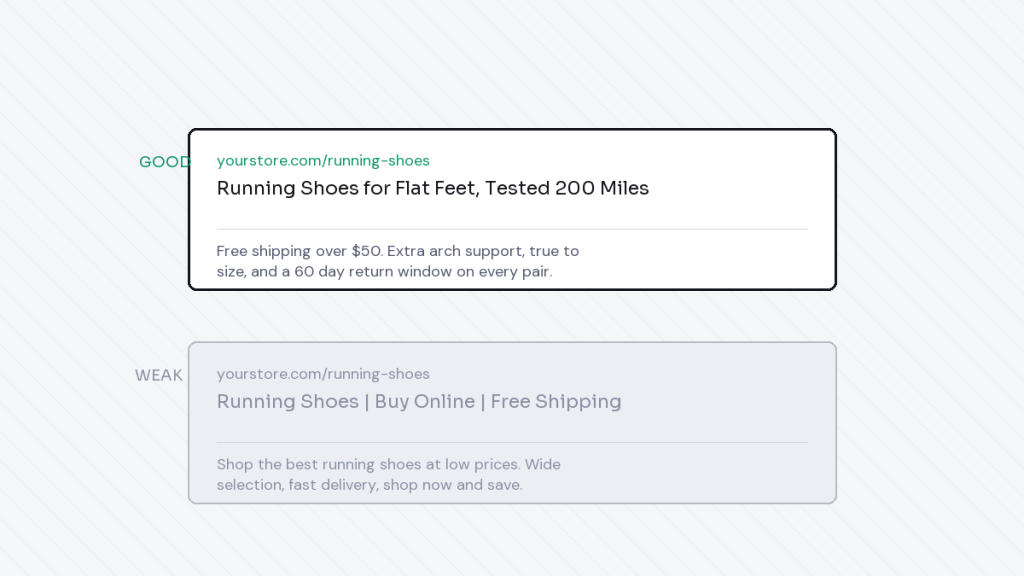
Weak: “Shop the best running shoes at low prices. Wide selection, fast delivery.”
Strong: “Running shoes built for flat feet, tested over 200 miles. Free shipping over $50 and a 60 day return window.”
Category page
Weak: “Browse our shoes collection online today.”
Strong: “Running, training, and walking shoes from 12 brands, filtered by size, width, and arch support.”
Blog post
Weak: “Learn about SEO and how it can help your business grow online.”
Strong: “A simple breakdown of how meta descriptions affect clicks, with real examples for product and category pages.”
Common mistakes to avoid
Using the exact same description across dozens of product pages. Search engines notice, and it wastes the opportunity entirely.
Writing a description that oversells the page, then delivering something different once someone clicks through. This hurts trust and increases how fast people leave.
Ignoring mobile truncation, so the important part gets cut off before anyone reads it.
Leaving the field blank and assuming Google will handle it well. Sometimes it does. Often it does not.
How to audit your store’s descriptions
Start with Search Console, not guesswork.
Look at pages with high impressions but low click through rate. These are pages people are seeing but skipping, which usually points to a weak title or description.
Fix the highest traffic pages first. A better description on your top ten product pages usually matters more than fixing fifty low traffic pages.
RankMath shows you a live preview of how your title and description will look in search results while you edit, which makes this process much faster.
What changed by 2026
AI generated summaries now sit above some search results, pulling from multiple sources at once.
This has not made meta descriptions useless. If anything, a clear, factual description makes it easier for both a human and an AI summary to represent your page accurately.
Vague, marketing heavy descriptions are the ones losing ground. Clear, specific ones are holding up fine.
Frequently asked questions
Do meta descriptions still matter in 2026
Yes, for clicks, not for ranking directly. A good one still improves how often people choose your result over a competitor’s.
Why does Google keep changing my description
Usually because the original does not closely match the search query, is too vague, or is missing entirely. A specific, well written description gets kept more often.
How long should a meta description be
Roughly one to two sentences, aiming for the most important information within the first 150 characters or so, since longer text often gets cut off.
Should every page have a unique description
Yes. Duplicate descriptions across many pages waste the opportunity and can make it harder for search engines to tell your pages apart.
The short version
Write the description. Keep it honest and specific. Let Google rewrite it if it wants to.
You lose nothing by writing a good one. You lose real clicks by leaving it blank or generic.
Dhanik
I build the automation and marketing systems that let ecommerce brands grow without adding more manual work: email and SMS flows, workflow automation, reporting, and the content and SEO that feeds all of it. Currently building these systems at TechDeliveryPartners, after four years running SEO and content at KonixWeb, and seven years total in search and digital marketing.
View full profile